$20 is a weird price for lip balm.
It is not luxury-lip-treatment shocking. It is not drugstore casual either. It sits right in the middle, where the product has to do more than smell nice and shine for ten minutes.
That is why I would judge Biossance Pro-Peptide Hydrating Lip Perfector Balm with Hyaluronic Acid by one real test: whether it makes dry lips easier to live with after the glossy first impression fades.
As of May 2026, Sephora lists the Biossance balm at $20 for 0.5 oz / 15 g, with more than 700 reviews and customer callouts around hydration, smoothness, and satisfaction. Biossance positions it as a vegan peptide lip balm with squalane, hyaluronic acid, a soft vanilla scent, and a glossy finish. The brand's own page also points to three shades: H2Glow, Blush Quartz, and Supernova.
That sounds good.
But lip products are where good claims go to get humbled. A balm can look beautiful for five minutes and still leave you reapplying all day. It can feel cushiony and still make lipstick slide. It can promise plumper-looking lips and still be less useful than a plain ointment when the corners of your mouth are cracked.
My short answer: I would consider Biossance Pro-Peptide Lip Perfector if your lips are dry, you like a glossy balm, and you want a daytime product that feels more polished than a basic stick. I would skip it if you need a bland repair ointment, if fragrance bothers your lips, if you want SPF, or if you hate reapplying glossy lip products.
The product is not hard to understand. The mistake is expecting it to be every lip product at once.

The quick read
| Detail | My read |
|---|---|
| Product | Biossance Pro-Peptide Hydrating Lip Perfector Balm |
| May 2026 price signal | $20 for 0.5 oz / 15 g |
| Texture lane | Glossy balm treatment |
| Best fit | Dry lips that want shine, cushion, and a more skincare-feeling balm |
| Main ingredients to notice | Squalane, glycerin, shea butter, sodium hyaluronate, palmitoyl tripeptide-1 |
| Main watch-out | Soft vanilla flavor/fragrance and no SPF |
| Routine slot | Daytime balm, makeup prep, desk balm, night layer if it feels lasting enough |
That last line is where I would start. A lip balm can be technically nice and still fail the slot you bought it for.
If you want a shine product, Biossance makes sense. If you want a dry-lip comfort product that looks prettier than ointment, it makes sense. If you want a severe-chapping rescue product you can apply once before bed and forget until morning, I would be more cautious.
What Biossance is trying to do
Biossance is not selling this like a plain wax stick.
The product story is skincare-coded: peptides, hyaluronic acid, squalane, 24-hour moisture language, smoother-looking lips, and a visibly plumper finish. That is the modern lip-treatment lane. It is less "I need something in my coat pocket" and more "I want my lip product to behave like part of my routine."
That lane can be useful. Lips dry out fast because they do not behave like the rest of the face. They get hit by talking, drinking, licking, weather, toothpaste, matte lipstick, spicy food, mouth breathing, and the small habit of rubbing them together every time they feel uncomfortable.
So a better lip balm has to do three jobs:
| Job | Why it matters |
|---|---|
| Soften | Dry lips need immediate comfort or you will keep touching them |
| Seal | Moisture disappears quickly without enough cushion |
| Behave | The product has to work under lipstick, alone, or during the day without becoming annoying |
Biossance is strongest when you want all three in a more elegant daytime format.
The ingredient story in plain English
The formula has a rich balm base, not a watery serum base.
That matters because hyaluronic acid in a lip product sounds exciting, but lips usually need more than water-binding ingredients. They need emollients and occlusive-feeling support so the surface does not keep drying out after the shine wears down.
The ingredients I would pay attention to are:
| Ingredient | Why I care |
|---|---|
| Squalane | Gives the balm a soft, skin-conditioning feel without making it seem like a heavy wax alone |
| Castor seed oil | Common in glossy lip products because it gives slip and shine |
| Shea butter | Adds richer comfort for dry lips |
| Glycerin | Humectant support in a balm context |
| Sodium hyaluronate | Hydration and plumping-feel support |
| Palmitoyl tripeptide-1 | The peptide part of the formula story |
| Sunflower seed wax and hydrogenated castor oil | Help create structure and staying feel |
| Ethyl vanillin | The soft vanilla scent/flavor signal, and the watch-out for sensitive lips |
That ingredient mix tells me this is trying to be a glossy comfort balm, not a thin lip oil. It also tells me why some people may love the feel while others may want something more boring.
If your lips react easily, flavor and fragrance matter. Ethyl vanillin is not automatically a problem, but the lip area can be dramatic. If vanilla-flavored balms usually make you lick your lips more, or if fragranced lip products make your mouth corners angry, that is a real reason to pause.
The 24-hour moisture claim
I would not buy a lip balm because of a 24-hour claim by itself.
I would ask what it means in real life.
Biossance shares consumer-study results around long-lasting hydration and immediate rescue for dry lips. That is useful context, but your day is not a controlled study. You drink coffee. You eat. You talk. You wipe your mouth. You apply sunscreen near the lip line. You maybe bite dry skin when you are stressed.
So the better test is not whether the tube can theoretically support long moisture. The better test is whether you are reaching for it every twenty minutes because the comfort disappears.
My practical standard would be:
| If this happens | My read |
|---|---|
| Lips feel softer after the shine fades | Strong sign |
| You reapply because you like the feel, not because lips feel worse | Good sign |
| Lips feel drier once it wears off | Bad sign |
| Corners sting or get red | Stop and simplify |
| Lipstick sits smoother after it settles | Useful makeup-prep role |
That is how I would make the claim useful without worshiping it.
The shade question
Biossance offers the balm in clear and tinted options.
That changes the decision a little. H2Glow is the simplest choice if you want the balm to work under other lip products or before makeup. Blush Quartz and Supernova make more sense if you want the balm itself to be the look.
I would choose based on habit:
| Your habit | Better direction |
|---|---|
| You wear lipstick or liner | Start with clear |
| You want a no-makeup lip | Try a tint |
| You reapply without a mirror | Clear is safer |
| You want your balm to replace gloss | A tint may feel more satisfying |
| Your lips are uneven in tone | A tint can look better, but test how it collects in dry lines |
Tinted balms can be lovely, but they also reveal texture. If your lips are peeling, a tinted glossy balm may catch on flakes. In that state, I would fix the dryness pattern before judging the color.
Where this beats a basic balm
Biossance beats a basic balm when you care about finish.
Some lip balms are useful but not beautiful. They protect. They soften. They sit there. That is enough at night, during a cold, on a ski trip, or when lips are truly cracked.
Biossance is more polished. It has the shiny, cushiony, skincare-makeup bridge feel. That makes it more appealing for daytime, especially if you want something you can use before a meeting, in the car, at your desk, or over a soft lip color.
I would buy it for that lane:
- dry lips that still want gloss
- makeup prep before lipstick
- a prettier balm for daytime
- a peptide-lip-treatment feel without sting
- a soft vanilla balm if that flavor suits you
That is a real lane. It is just not the only lane.
Where a boring ointment still wins
If my lips were cracked, bleeding, windburned, or reacting, I would not start here.
I would go boring first. Plain petrolatum-style ointment, simple barrier balm, fewer flavors, fewer tints, fewer things to evaluate. Once the lips calm down, then I would decide whether I want a prettier daytime product.
The lip area is easy to overcomplicate because the product feels small. But small products can still irritate. If your mouth corners are split or your lip border is red, you do not need a more exciting balm. You need a quieter few days.
I would also be careful if you have a history of allergic contact dermatitis around the lips. In that case, vanilla flavor, tint, essential oils, lanolin, propolis, menthol, mint, cinnamon, and certain sunscreen filters can all become part of the investigation depending on the person.
Biossance may be comfortable for many people. That does not make it the blandest choice.
The makeup-prep test
This is the test I would actually run.
Use Biossance before makeup, then wait. Do not put lipstick on immediately. Give the balm a little time to soften the lips, then blot if needed.
Watch three things:
- Does lipstick glide better?
- Does the color slip around?
- Do dry lines look softer or more obvious?
If a balm makes lipstick slide, it may still be good. It just may belong after lipstick, on bare-lip days, or at night. If it softens dry lines without making the lip product move, that is where it earns its place.
For a $20 tube, I would want it to be useful in more than one situation. Bare lips, makeup prep, and desk reapplication would be the three slots I would test.
How it compares to other peptide lip treatments
The peptide lip category is crowded now.
That is not a bad thing. It just means Biossance needs a clear reason to be your pick.
| Product lane | Best fit | Where Biossance stands |
|---|---|---|
| Biossance Pro-Peptide Lip Perfector | Glossy balm with squalane, hyaluronic acid, peptide, and vanilla comfort | Best if you like Biossance's soft balm feel and want a skincare-gloss hybrid |
| Rhode Peptide Lip Treatment | Trend-driven glossy peptide balm lane | Better if you already love the Rhode texture and flavors |
| Ole Henriksen Pout Preserve | Richer peptide treatment lane with stronger cushion reputation | Better if you want a plusher lip-treatment feel |
| The INKEY List Tripeptide Plumping Lip Balm | Lower-cost peptide-plumping lane | Better if budget matters more than polish |
| Plain ointment | Bland repair lane | Better for cracked, reactive, or stripped lips |
I would not choose Biossance because it has peptides. A lot of products have peptides now. I would choose it if the whole formula sounds like my lane: glossy, squalane-rich, softly scented, hydrating, and easy to reapply.
When I would use it
I would keep Biossance in three places.
First, the desk. This is the obvious reapplication product. It looks nice, feels like a treat, and does not require a full mirror moment if you choose the clear shade.
Second, the makeup drawer. It makes sense before lipstick if your lips get dry under color. Just give it time to settle.
Third, the nightstand if it lasts long enough for you. Some people will want something thicker at night. That is fine. A product can be a great daytime balm and still not be your overnight rescue product.
The routine version is simple:
| Moment | How I would use it |
|---|---|
| Morning | Apply a thin layer after skincare, before lip color if needed |
| Makeup prep | Let it sit, then blot before lipstick |
| Daytime | Reapply when lips feel dry, not every time you feel bored |
| Night | Use if lips wake up softer; switch to ointment if they do not |
That last line matters. Lip balm can become a fidget object. If you are applying it every ten minutes, something else may be going on: licking, dehydration, irritation, dry air, toothpaste sensitivity, medication dryness, or a formula that is not sealing enough.
Who should buy it
I would buy Biossance Pro-Peptide Lip Perfector if I wanted a lip balm that feels more like skincare than a basic tube.
The best fit is someone who says:
- my lips are dry but not severely cracked
- I like glossy balms
- I want something smoother than a wax stick
- I like vanilla lip products
- I want a balm that can double as a soft gloss
- I care about squalane and hyaluronic acid in the formula
- I do not need SPF from this product
That person will probably understand the $20 price faster than someone who just wants a pocket balm.
Who should skip it
I would skip it if your lips need medical-level boring.
That means active cracking, burning, swelling, recurring mouth-corner splits, or a pattern where flavored lip products make things worse. I would also skip it if you need sun protection. This is not your SPF lip balm.
I would pause if:
- vanilla flavor makes you lick your lips
- glossy products make your hair stick to your mouth all day
- you hate squeeze tubes
- you want a matte balm
- your lips are peeling badly
- your budget makes $20 feel annoying
- you already own a balm that keeps your lips comfortable
That last one is not a joke. If your current balm works, you do not need to upgrade just because the peptide category is loud.
The mistake I would avoid
I would not use a pretty balm to ignore a dry-lip pattern.
If your lips are always cracked, look at the boring causes. Are you licking them? Sleeping with your mouth open? Using a drying toothpaste? Wearing matte lipstick daily? Getting retinoid or benzoyl peroxide too close to the mouth? Drinking less water than usual? Living in dry air? Picking flakes?
A good balm helps. It does not cancel every habit.
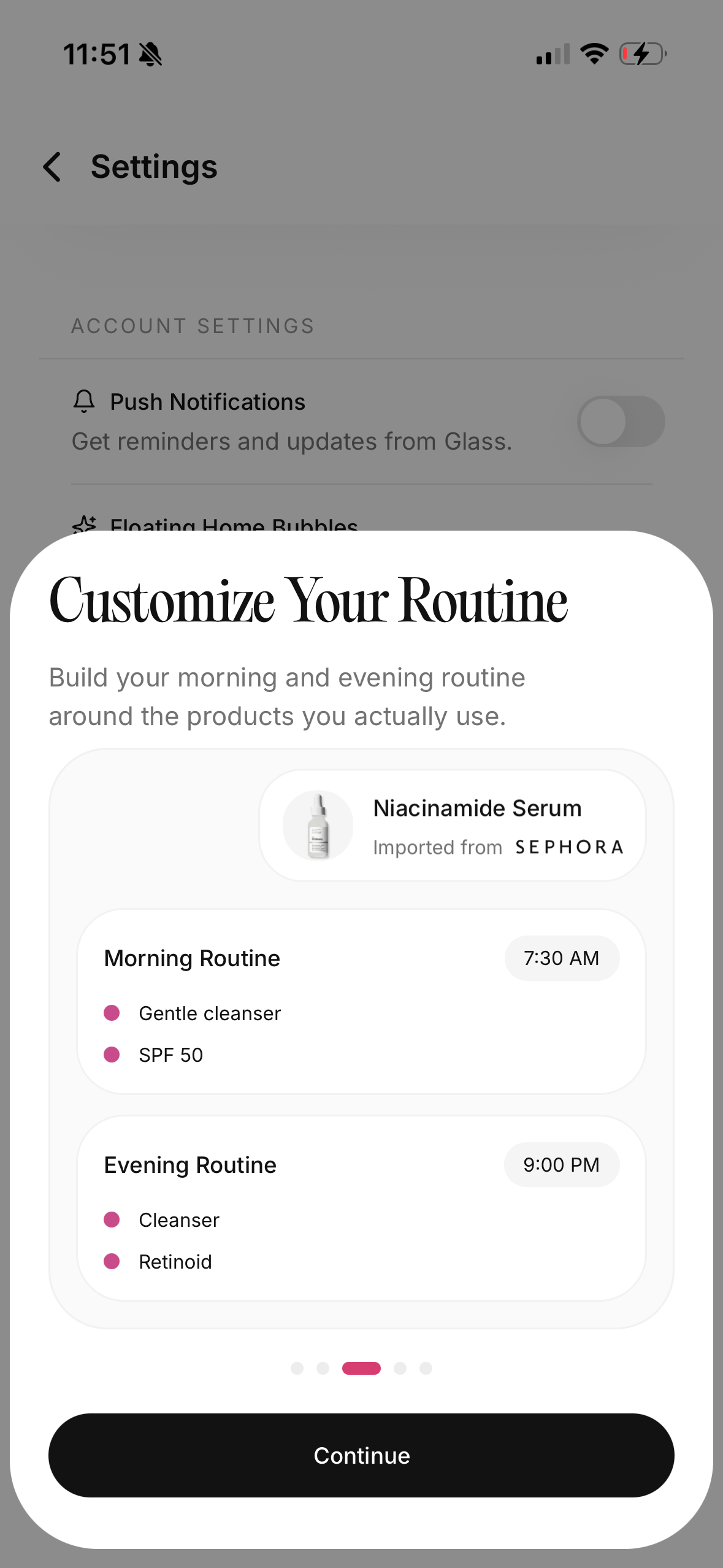
Use Glass to track the product like any other routine variable if your lips keep reacting. Add the balm, keep the rest of the routine steady, and note whether dryness, peeling, and comfort actually improve. If you are also changing toothpaste, lipstick, cleanser, acne treatment, and sunscreen that week, you will not know what happened.
My bottom line
Biossance Pro-Peptide Hydrating Lip Perfector Balm makes sense as a polished, glossy, skincare-feeling lip balm for dry lips that want comfort and shine.
I like the formula direction. Squalane, shea butter, castor oil, glycerin, sodium hyaluronate, and a peptide make more sense together than a thin gloss pretending to be treatment. The $20 price also feels understandable if you use it as a daytime balm, makeup-prep product, and soft gloss.
I would not use it as my only answer for cracked, reactive, or severely chapped lips. I would not buy it for SPF. I would not buy it only because the word peptide is on the tube.
The cleanest decision is this: buy it if you want a prettier dry-lip balm that still feels like skincare. Skip it if your lips need the quietest possible repair product.
Useful references: Biossance Pro-Peptide Lip Perfector, Sephora Biossance Pro-Peptide Hydrating Lip Perfector listing, Allure peptide lip treatment roundup, and AAD dry skin relief guidance.