
Greenfield is not Boston.
That matters.
When you are comparing dermal fillers in a smaller Western Massachusetts market, the decision feels different from scrolling through endless big-city injector pages. You are not choosing from hundreds of clinics. You are sorting a tighter local map: dermatology, cosmetic injection studios, salon-based aesthetics, oral surgery, skin-care providers, and nearby Northampton or Springfield options if the treatment gets more complex.
That can be easier.
It can also make the first appointment riskier if you book too fast.
If I were comparing dermal fillers in Greenfield, MA in June 2026, I would not start with the lowest syringe price. I would start by deciding whether I actually need filler at all.
Filler changes structure.
Botox changes movement.
Laser, microneedling, peels, PRP, facials, and skin care change skin quality.
Those lanes can support each other, but they should not be confused. A movement line does not need filler first. A hollow or shape concern does not get fixed by a glow facial. Rough texture, pigment, acne marks, and dullness usually need a skin plan before anyone starts adding volume.
My quick read on Greenfield
Greenfield has a smaller provider set, but it is not empty. Glass has a Greenfield skin care directory, a Greenfield micro-area comparison page, and treatment pages for fillers, Botox, laser, microneedling, and chemical peels.
I would use those pages as a map, not as a verdict.

Provider guide
Bridge Primary Dermatology
Open the provider guide to compare services, site details, and fit before booking.
Provider guide
Cosmetic Injections by Yulia
Open the provider guide to compare services, site details, and fit before booking.
Provider guide
Lavish The Salon
Open the provider guide to compare services, site details, and fit before booking.
Provider guide
Connecticut Valley Oral Surgery Associates
Open the provider guide to compare services, site details, and fit before booking.
Provider guide
Yasou Electrolysis & Skin Care
Open the provider guide to compare services, site details, and fit before booking.
The local mix is practical. Bridge Primary Dermatology lists dermatology and cosmetic services in Greenfield, including Botox/neurotoxins, fillers, laser skin treatment, PRP, microneedling, chemical peels, acne care, and skin-care consultations. Cosmetic Injections by Yulia lists Botox, Dysport, Xeomin, dermal fillers, Kybella, PRP facial rejuvenation, Sculptra, PRX Derm Perfexion, and a conservative one-on-one injection approach in Greenfield. Lavish The Salon lists facials, chemical peels, Botox, dermal fillers, and related beauty services. Connecticut Valley Oral Surgery Associates has cosmetic injection and filler information tied to Greenfield and Northampton.
That is enough choice to compare.
It is not enough choice to stop asking questions.
The first thing I would decide
I would write down the exact thing I want changed.
Not the treatment.
The thing.
"My lips look flatter than they used to."
"My smile lines look deeper in daylight."
"My lower face feels heavier."
"My under-eyes look hollow even when I sleep."
"My cheeks have lost support."
"My skin looks rough, but I cannot tell if it is volume loss or texture."
That sentence changes the appointment. If the concern is a line that appears when you move your face, I am thinking about Botox or another wrinkle relaxer first. If the concern is shape, shadow, projection, or volume, filler may belong in the conversation. If the concern is roughness, pigment, pores, acne scars, redness, or dullness, I would compare skin treatments before assuming a syringe is the answer.
Here is the filter I would use before spending money:
| What you notice | What I would discuss first | What I would be careful about |
|---|---|---|
| Forehead lines, frown lines, or crow's feet that show when you move | Botox, Dysport, Xeomin, or another wrinkle relaxer | Filling a movement line before relaxing the muscle pattern |
| Lips, cheeks, chin, jawline, or folds look flatter than before | Conservative filler consult | Chasing every normal fold until the face looks puffy |
| Under-eyes look hollow or shadowed | Medical-level consult, anatomy review, sometimes no filler | Treating under-eyes like a beginner area |
| Skin looks dull, rough, congested, or uneven | Facial, peel, microneedling, laser, acne plan, barrier repair | Expecting filler to fix skin texture |
| Brown spots, redness, sun damage, or acne marks | Laser, IPL, peels, dermatology-style pigment plan | Using filler when the issue lives in the skin |
| You cannot describe the concern clearly | Consultation only | Same-day treatment pressure |
The last row matters most.
If I cannot explain what bothers me without pointing at a filtered photo, I do not want anyone adding volume yet. I want the provider to help separate anatomy, lighting, skin quality, inflammation, dental changes, weight change, and aging patterns before a syringe comes out.
Filler is not one decision
I do not think of filler as one category.
Lip filler, cheek filler, chin filler, jawline filler, nasolabial fold filler, temple filler, and under-eye filler are different decisions. They use different anatomy. They carry different risks. They can age differently. They can also change the whole balance of the face even when the amount used is small.
That is why I would never ask only, "How much is one syringe?"
The better question is, "What would one syringe actually do on my face?"
In Greenfield, that question matters because the local market includes different practice types. A dermatology office may be stronger for medical skin context, pigment, acne, device-based work, and skin cancer awareness. A focused injection studio may be stronger for subtle facial balancing and one-on-one aesthetic planning. A salon-based provider may be convenient for lighter beauty-adjacent services, but I would still ask who performs injections, what license they hold, where the product comes from, and what happens if there is a complication.
The category does not decide the quality.
The consult does.
What I would ask before filler
Before dermal filler, I would want calm, specific answers.
Not charm.
Not pressure.
Answers.
I would ask:
- Which filler are you recommending, and why that one?
- Is it hyaluronic acid filler, biostimulatory filler, or something else?
- What area are you treating first?
- What would you refuse to do on my face?
- How much product would you start with?
- What result is realistic from that amount?
- What could make me look overfilled?
- What are the vascular risk areas for this treatment?
- Do you keep hyaluronidase available for hyaluronic acid filler complications?
- What should I do if I notice severe pain, blanching, mottled color, vision changes, or unusual swelling?
- Who handles follow-up if I am worried after hours?
That might sound intense.
It should be normal.
The FDA describes dermal fillers as injectable implants used to create a smoother or fuller appearance in areas like folds, cheeks, chin, lips, and hands. That framing is useful because it reminds me that filler is not just a beauty add-on. It is an implanted medical device.
I am not saying filler is bad.
I am saying it deserves adult questions.
When I would choose Botox instead
If the line changes when I move, I would usually discuss Botox before filler.
Forehead lines, eleven lines, crow's feet, bunny lines, chin dimpling, lip flip questions, and some jaw tension concerns often sit in the movement lane. Filler may help structure, but it does not stop a muscle from folding the skin in the same place again and again.
For Greenfield, I would ask the provider to watch my face move before recommending a dose. I would raise my brows, frown, squint, smile, talk, purse my lips, and relax. I would want to hear what they see.
The answer I trust is specific.
"Your brows sit low, so I would be conservative on the forehead."
"Your frown muscles are stronger on this side."
"I would not chase that line with filler because it is mostly movement."
"I would rather start lighter and reassess than freeze too much expression."
That kind of answer tells me the provider is treating a face, not a unit package.
The CDC advises people to get botulinum toxin injections from licensed and trained professionals using authorized product sources. I would treat that as baseline, not bonus. If a place cannot explain licensing, product source, dosing, contraindications, and follow-up, I would not let a discount make the decision for me.
When I would choose skin work first
Sometimes the face does not need volume.
It needs better skin quality.
That is easy to miss because filler feels more dramatic. A syringe can change shape quickly. But if the real issue is dullness, texture, congestion, sun damage, acne marks, fine crepiness, dehydration, or makeup catching on rough patches, filler can make the face look fuller without making the skin look healthier.
In Greenfield, I would compare skin work first if my concern sounded like this:
| Concern | First lane I would compare |
|---|---|
| Rough makeup texture | Facial, peel, microneedling, barrier repair |
| Brown spots or sun damage | IPL, laser, chemical peel, pigment plan |
| Acne marks or shallow texture | Microneedling, peel series, laser consult |
| Dull, tired-looking skin | Hydrating facial, gentle exfoliation, home routine reset |
| Redness or reactive skin | Dermatology consult, calmer routine, trigger review |
| Fine crepiness without real volume loss | Microneedling, laser, skin-care plan, sometimes biostimulatory discussion |
Bridge Primary Dermatology's public service mix makes this point well because it lists both injectable and skin-quality lanes: Botox, fillers, laser, PRP, microneedling, chemical peels, acne care, and consultations. That is the kind of menu where I would want the provider to explain why one lane comes before another.
If a clinic can only sell the treatment you asked about, I would be cautious.
If they can tell you why not to do it yet, I pay attention.
How I would compare Greenfield providers
I would sort the local options by the appointment type I actually need.
For a conservative lip, cheek, chin, or facial balancing consult, I would look closely at injection-specific experience, before-and-after consistency, product choice, complication planning, and whether the provider's style matches my face. A subtle injector and a dramatic injector can both be talented, but they are not interchangeable.
For Botox, I would focus on movement assessment, dosing philosophy, product source, and whether follow-up is available. I would avoid anyone who treats every forehead the same way.
For laser, pigment, acne, rosacea, or medical skin concerns, I would put more weight on dermatology context and device experience. I would want to know what skin tones they treat often, what settings they use, what downtime looks like, and how they prevent post-inflammatory hyperpigmentation.
For facials, peels, and barrier repair, I would care more about skin reading, ingredient judgment, and restraint. A facial can be wonderful. It can also irritate skin that needed less, not more.
For under-eye filler, deep folds, temples, nose-adjacent work, or anything close to higher-risk anatomy, I would widen the search if the local answers were not extremely clear. I do not think convenience should win over anatomy.
The price question I would ask differently
I would still ask price.
I just would not ask it first.
For filler, a low syringe price can be misleading because the real cost depends on product type, amount, area, follow-up, correction risk, and whether the plan is staged. One syringe used well can look better than three syringes used casually. A staged plan can cost more slowly and look more natural than trying to solve everything in one appointment.
I would ask:
- What is the price per syringe or per treatment area?
- Is the consult fee separate or applied to treatment?
- What product does that price include?
- How long do you expect this result to last?
- Do you recommend one visit or a staged plan?
- What happens if I need a small adjustment?
- What would dissolving cost if I dislike the result?
That last question is uncomfortable, but I would ask it anyway.
Good providers are not offended by thoughtful questions. They may not promise perfection, and they should not. But they should be able to explain the plan, the tradeoffs, the follow-up, and the risk without making you feel difficult.
My conservative Greenfield booking plan
If I were starting from zero in Greenfield, I would use a simple sequence.
First, I would decide the concern: movement, volume, or skin quality.
Second, I would open the local pages for Greenfield providers, fillers, Botox, laser, microneedling, and chemical peels.
Third, I would shortlist two or three providers by fit, not popularity.
Fourth, I would book consultation first if the treatment involved filler, deeper laser, under-eye work, or anything I could not clearly explain.
Fifth, I would keep the first treatment conservative.
That might mean a lighter Botox dose. It might mean one area of filler instead of full-face balancing. It might mean skin work before filler. It might mean doing nothing that day and leaving with a plan.
I would rather have a boring first appointment than an expensive correction story.
How Glass fits into the decision
I like having my skin history organized before aesthetic appointments because memory gets messy in the chair.
It is easy to forget when you started retinoid, which moisturizer caused burning, whether your skin looked better before a cleanser swap, or how often your cheeks get red after exfoliation. It is also easy to overreact to one bad photo and spend money on the wrong problem.
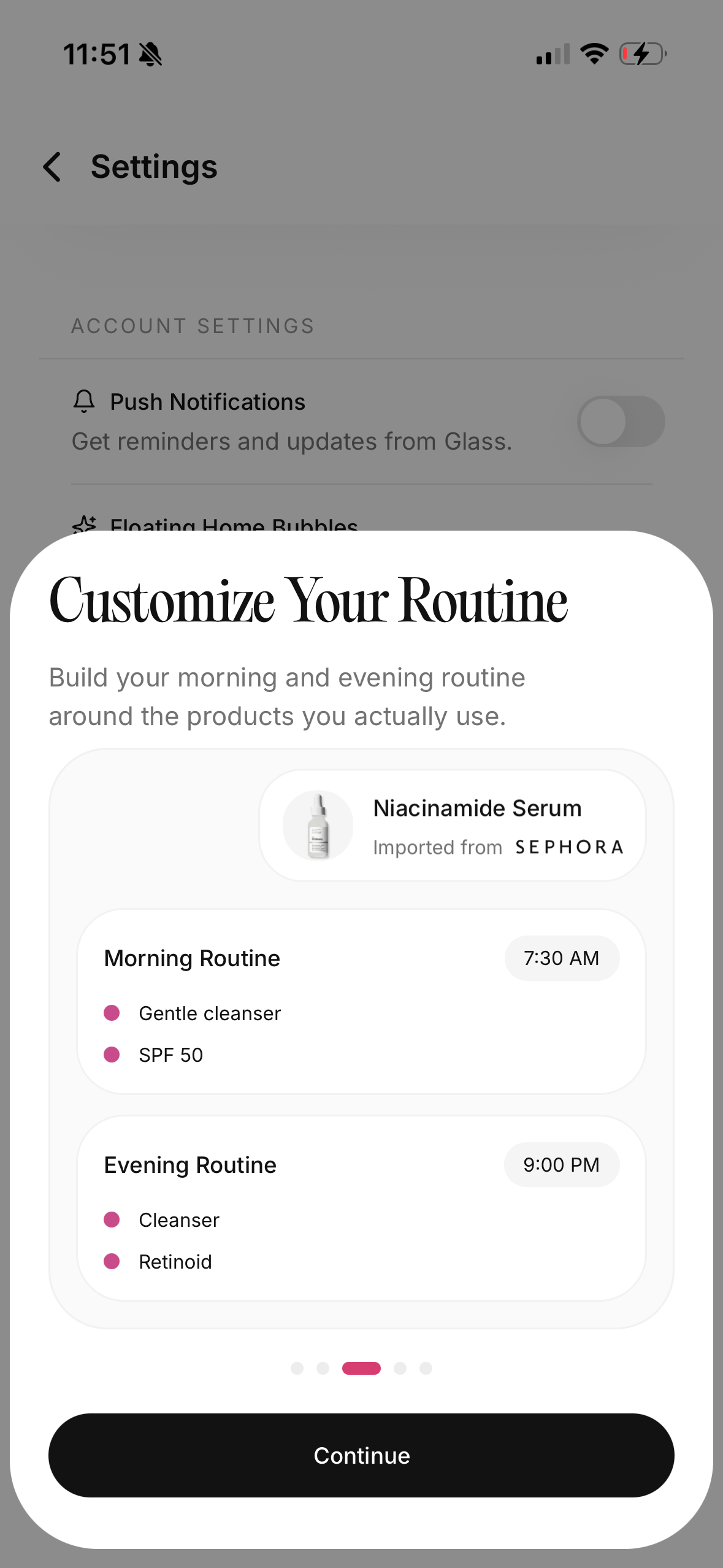
With Glass, I would keep routine notes, product changes, skin scans, progress photos, and appointment notes in one place before comparing Greenfield providers. That gives the consultation more context. It also gives you a calmer way to judge results later.
If you get filler, you can track swelling, bruising, settling, and whether the change still looks right after two weeks.
If you get Botox, you can track when it starts, when it peaks, and whether the dose felt too light or too heavy.
If you choose peels, laser, microneedling, or facials, you can track texture, redness, pigment, breakouts, and barrier changes instead of guessing from memory.
The point is not to turn your face into a project.
The point is to stop making decisions from panic.
What would make me walk away
I would walk away from any appointment that made the decision feel rushed.
I would also walk away if a provider:
- Could not explain their license or supervision
- Could not name the product being used
- Dismissed vascular risk questions
- Pushed under-eye filler casually
- Promised a perfect result
- Wanted to fix every line in one visit
- Treated swelling-heavy after photos as the final look
- Made me feel awkward for asking about complications
- Offered a price that only made sense if I booked immediately
None of that means the provider is automatically unsafe.
It means I would not spend money there.
The best aesthetic consults feel steady. You leave understanding the face better than when you arrived. You know what the treatment can do, what it cannot do, what it costs, what can go wrong, and what the next step is if you decide to wait.
That is the bar I would use in Greenfield.
My final take
If I were comparing dermal fillers in Greenfield, MA in June 2026, I would treat the local market as useful but small.
I would start with Greenfield providers because there are real local options for injectables, dermatology, skin care, peels, laser-adjacent services, and conservative consults. I would not assume I need to drive to a bigger city for every appointment.
But I would also be honest about complexity.
For simple, conservative Botox or a clear filler question, Greenfield may give you enough to compare. For under-eyes, complex facial balancing, deeper laser, pigment-prone skin, or revision work, I would widen to Northampton, Springfield, or another experienced medical aesthetics market if the local answers are not specific enough.
The goal is not to find the closest syringe.
The goal is to choose the right first step.
For me, that means movement before Botox, structure before filler, skin quality before resurfacing, and a consultation that makes the plan feel calmer instead of more confusing.
Quick answers
Should I get filler or Botox first in Greenfield?
If the line appears mainly when your face moves, I would ask about Botox first. If the concern is volume, shape, lips, cheeks, chin, or facial balance, filler may belong in the conversation. If the issue is texture, pigment, acne marks, or dullness, I would compare skin treatments first.
Are dermal fillers safe?
Dermal fillers are medical devices, and safety depends on product choice, anatomy, provider training, sterile technique, complication planning, and follow-up. I would only consider a provider who can explain the filler, the area being treated, the risks, and what to do if something feels wrong afterward.
How much filler should I start with?
I would start conservatively. The right amount depends on the area, your anatomy, your goal, the filler type, and whether the provider recommends staging. I would rather build slowly than look overfilled and need correction.
When should I leave Greenfield for a bigger market?
I would widen the search for under-eye filler, complex facial balancing, revision work, deeper resurfacing, significant pigment risk, or any treatment where the local consult feels vague. Convenience matters, but it should not outrank experience for higher-risk areas.
What should I bring to a filler consult?
Bring current photos, older photos, a list of medications and supplements, your skincare routine, prior filler or Botox history, allergy history, and a clear sentence about what bothers you. I would also bring questions about product source, licensing, follow-up, and complication handling.
Useful references: FDA dermal filler safety information, FDA-approved dermal fillers, CDC botulinum toxin injection safety guidance, FDA counterfeit Botox warning, Bridge Primary Dermatology, Cosmetic Injections by Yulia, Lavish The Salon, and Connecticut Valley Oral Surgery Associates Botox information.