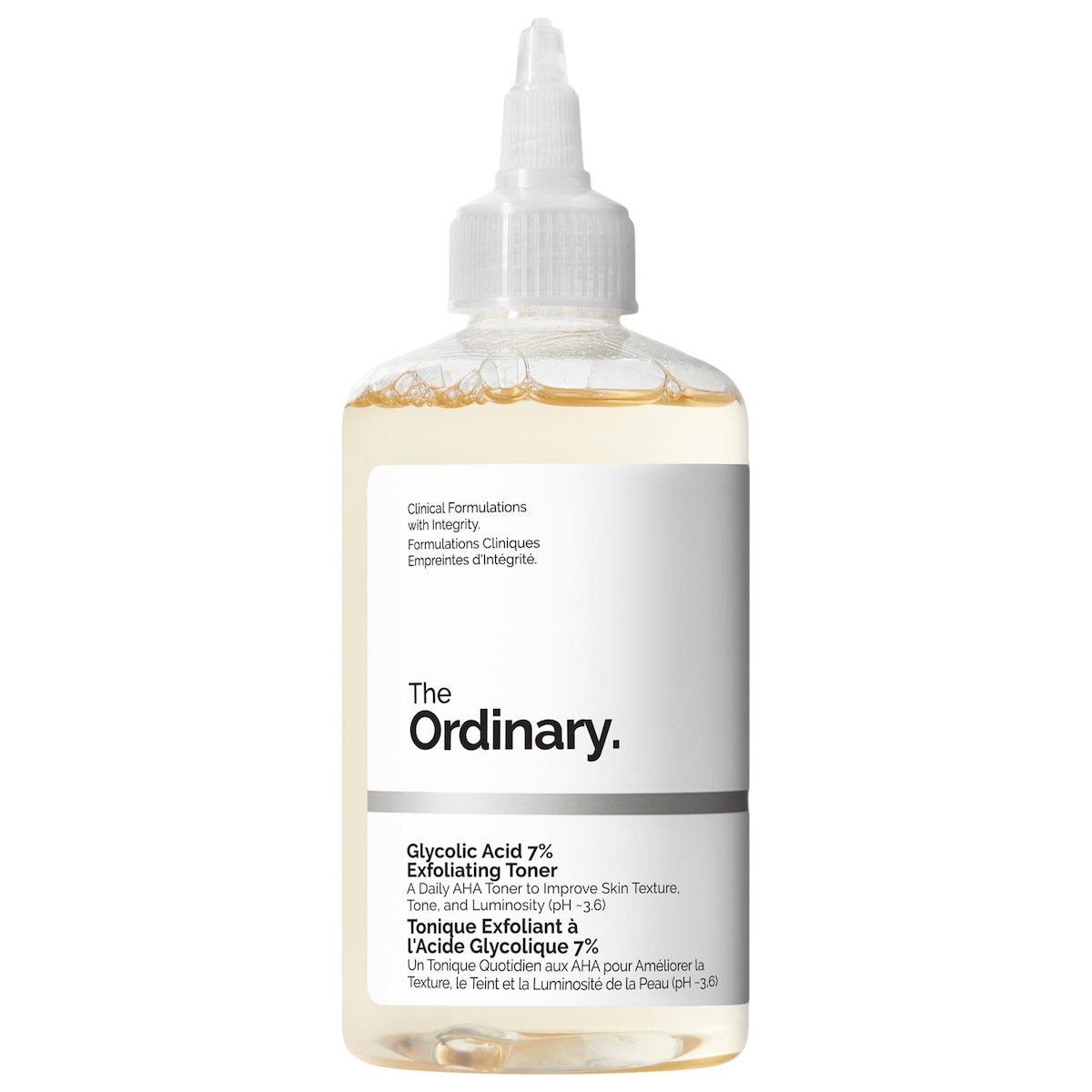
The Ordinaryglycolic acid tonerExfoliate stepSephora bestseller

The Ordinary Glycolic Acid 7% Exfoliating and Brightening Daily Toner

This toner is a workhorse for anyone looking to tackle dullness, uneven texture, and a generally lackluster complexion. Its primary active, glycolic acid, is a well-researched alpha hydroxy acid (AHA) known for its ability to break down the bonds holding dead skin cells together. This allows them to shed more easily, revealing smoother, brighter skin underneath. The water-based formula makes it feel light, and it's intended to be used after cleansing to prep the skin for subsequent treatments.

Sephora price

$13.00

Price matters most when you are trying to learn whether this lane belongs in your routine without turning the test into a luxury gamble.

Sephora reviews

4.4 / 5

About 5,800 reviews on the current Sephora source, so there is real volume behind the reputation.

Shoppers keep mentioning

TextureDullnessUneven tone

These are the shopper themes that keep showing up around this listing and shape why people open it in the first place.

Glass take

4.3 / 5 overall fit

This is a straightforward, effective glycolic acid toner that delivers on its promise of smoother, brighter skin. It’s a solid choice for those looking to introduce chemical exfoliation, but it requires careful integration into a routine to avoid irritation. The score reflects its efficacy for its intended purpose, but also the potential for overuse.

The Ordinary Glycolic Acid 7% Exfoliating and Brightening Daily Toner

Sephora snapshot refreshed April 23, 2026

Price, rating, review count, and source status come from Sephora. Glass adds the routine fit, overlap risk, and what to compare next.

View Sephora

What Sephora says

What this product is supposed to do

A water-based glycolic acid toner made for surface exfoliation, visible dullness, and rough texture.

DullnessUneven textureUneven tone

Use at night after cleansing.

Start a few nights per week instead of daily if your skin is new to acids.

Do not stack with other strong exfoliants or retinoids in the same routine until tolerance is clear.

What Glass adds

What actually matters before you buy it

Glass sees this as a potent, no-nonsense glycolic acid toner. It’s effective for its stated purpose: improving texture and brightness through exfoliation. The main consideration is how you integrate it. If your skin is already accustomed to acids or you’re looking for a strong exfoliant to address dullness and rough patches, this is a solid, budget-friendly choice. However, if your skin is sensitive, easily irritated, or already packed with other strong actives like retinoids or other exfoliants, you’ll need to be very strategic with its use to avoid overdoing it.

Routine Fit is Key

Many users emphasize that the success of this toner hinges on how it's incorporated. Those who start slow and avoid layering with too many other actives report the best results and fewest issues.

Texture and Brightness Wins

The most common praise revolves around the tangible improvements in skin smoothness and a more radiant complexion. Users often mention that their skin feels softer and looks less dull.

Value Proposition

The affordability is frequently highlighted as a major plus, making powerful exfoliation accessible without a premium price tag. It's seen as a smart buy for those who know they want glycolic acid.

Best for

When this is a smart buy

  • People looking to improve skin texture and brightness with a chemical exfoliant.
  • Normal to oily skin types that can tolerate AHAs.
  • Those seeking an effective, budget-friendly exfoliating toner.
  • Individuals wanting to address mild congestion and dullness.

Skip if

When this is the wrong lane

  • Your skin is very dry, sensitive, or prone to redness and irritation.
  • You are already using multiple strong actives like retinoids, other AHAs, or BHAs in your routine.
  • You prefer a gentler exfoliation method or a product focused on hydration.
  • You are not diligent about using sunscreen daily, as AHAs increase sun sensitivity.

Why it's a Staple

The Power of Glycolic Acid: Why This Toner Works

This toner's main draw is its straightforward approach to exfoliation. Glycolic acid, a potent AHA, is the star player here. It works by dissolving the 'glue' that holds dead skin cells to the surface, allowing them to slough off. The result? Smoother skin, reduced appearance of dullness, and a brighter, more even tone. It's a classic ingredient for a reason, and The Ordinary delivers it in a no-frills, water-based formula that’s easy to understand and use, provided you respect its strength.

Where Routines Can Go Wrong

The Pitfalls: When This Toner Becomes Too Much

The biggest mistake people make with potent exfoliants like this is thinking 'more is better.' This toner is strong, and using it daily from the start, or layering it with other strong actives like retinoids or other acid toners, can quickly lead to a compromised skin barrier. Symptoms include increased sensitivity, redness, peeling, and even breakouts. The key is to introduce it gradually, perhaps a few nights a week, and to ensure your routine has a good balance of hydration and barrier support.

My Approach

How I’d Use This Toner for Best Results

If this toner was in my cabinet, I'd reserve it for nighttime use, after cleansing. I'd start by using it just two or three times a week, on nights I wasn't using any other strong actives like a retinoid or a different exfoliant. I'd pay close attention to how my skin felt the next morning – was it calm, or was it tight and irritated? If it felt good, I might slowly increase the frequency. If my skin felt anything less than happy, I'd stick to the lower frequency or use it even less often. Sunscreen is non-negotiable during the day, always.

Why it works

Where it earns the slot and where it does not

The useful question is not whether this product is good in a vacuum. It is whether it makes your routine easier to run or just adds one more bottle with a familiar ingredient on it.

What it actually does well

  • High concentration of glycolic acid for effective exfoliation.
  • Noticeably improves skin texture and brightness over time.
  • Competitive price point for the active ingredient strength.
  • Water-based formula feels light and layers well under other products.

Where it starts to feel redundant

  • Can cause irritation, redness, or peeling if overused or if skin is not accustomed to acids.
  • Increases sun sensitivity, requiring diligent sunscreen use.
  • Not suitable for very sensitive or compromised skin barriers without extreme caution.
  • The 'toner' format might be redundant if you already use other exfoliating treatments.

Routine fit

Where it belongs in the stack

Morning Fit

Generally not recommended for morning use due to increased sun sensitivity. If you must, ensure rigorous SPF application and monitor for irritation.

Night Fit

Ideal for nighttime use after cleansing. It serves as an effective exfoliation step before serums and moisturizers. Start with a few nights a week and adjust based on tolerance.

Pairing Rule

Avoid pairing with other strong exfoliants (like BHAs or other AHAs) or retinoids in the same routine, especially when starting. Focus on hydration and barrier support with your other products.

Glass rating

How this formula scores in real life

4.3/ 5 overall

This is a straightforward, effective glycolic acid toner that delivers on its promise of smoother, brighter skin. It’s a solid choice for those looking to introduce chemical exfoliation, but it requires careful integration into a routine to avoid irritation. The score reflects its efficacy for its intended purpose, but also the potential for overuse.

Exfoliation Power

4.7 / 5

The 7% glycolic acid is potent enough to make a noticeable difference in skin texture and brightness. It effectively sloughs off dead skin cells.

Routine Integration

3.9 / 5

It fits well as an exfoliant step, but the key is frequency. Overdoing it with other actives can lead to irritation, hence the score reflects the need for careful management.

Skin Type Fit

4.2 / 5

Best for normal to oily skin types that can handle acids. Dry or sensitive skin needs to approach with caution and lower frequency.

Value for Money

4.5 / 5

For the concentration and effectiveness, the price point is very competitive, making it an accessible option for many.

Ingredient Quality

4.1 / 5

While glycolic acid is the star, the inclusion of botanical waters and amino acids aims to buffer the potential harshness, though the acid itself is the main driver.

Full ingredient breakdown

Every ingredient, what it does, and whether I care

Base Solvent

Water

Badness

0.2 / 10

The foundation of the toner, providing a lightweight base for the active ingredients.

Usually helps with

Ensuring the formula is spreadable and not too heavy.

Watch for

This is a neutral ingredient, serving primarily as a carrier.

Exfoliant

Glycolic Acid

Badness

6.5 / 10

The star ingredient. This alpha hydroxy acid (AHA) effectively exfoliates the skin's surface, promoting cell turnover for brighter, smoother skin.

Usually helps with

Improving texture, reducing dullness, and addressing uneven tone.

Watch for

Can cause irritation, redness, and increased sun sensitivity, especially at higher concentrations or with frequent use.

Soothing Botanical

Rosa Damascena Flower Water

Badness

1.0 / 10

Derived from rose petals, this ingredient offers a pleasant scent and has mild soothing properties.

Usually helps with

Adding a touch of calming botanical essence to the formula.

Watch for

Generally well-tolerated, but fragrance can be a concern for highly sensitive individuals.

Soothing Botanical

Centaurea Cyanus Flower Water

Badness

1.0 / 10

Also known as cornflower water, it's often used for its calming and anti-inflammatory benefits.

Usually helps with

Providing gentle soothing effects.

Watch for

Similar to rose water, it's a botanical extract that's typically fine for most skin types.

Hydrating and Soothing

Aloe Barbadensis Leaf Water

Badness

1.5 / 10

Soothes and hydrates the skin, helping to counteract some of the potential dryness or irritation from the glycolic acid.

Usually helps with

Adding a layer of hydration and calming the skin.

Watch for

A beneficial ingredient that supports skin comfort.

Humectant and Solvent

Propanediol

Badness

1.2 / 10

A solvent that also acts as a humectant, drawing moisture to the skin and improving the texture of the formula.

Usually helps with

Enhancing hydration and product feel.

Watch for

A common and generally well-tolerated skincare ingredient.

Humectant

Glycerin

Badness

0.5 / 10

A classic humectant that attracts water to the skin, helping to keep it hydrated and plump.

Usually helps with

Boosting moisture levels and improving skin barrier function.

Watch for

A staple ingredient for hydration, usually very well tolerated.

pH Adjuster

Triethanolamine

Badness

3.5 / 10

Used to adjust the pH of the formula. At higher concentrations or in certain formulations, it can be an irritant.

Usually helps with

Ensuring the product has the correct pH for efficacy and stability.

Watch for

Can be irritating for some individuals, especially those with sensitive skin. Its presence is noted due to potential sensitivity.

pH Adjuster

Aminomethyl Propanol

Badness

3.0 / 10

Another pH adjuster, often used as an alternative or in conjunction with Triethanolamine.

Usually helps with

Stabilizing the formula's pH.

Watch for

Similar to Triethanolamine, it can be a potential irritant for sensitive skin.

Antioxidant and Skin Conditioning

Panax Ginseng Root Extract

Badness

1.8 / 10

Known for its antioxidant properties and potential to improve skin vitality.

Usually helps with

Providing antioxidant benefits and supporting skin health.

Watch for

A beneficial botanical extract.

Soothing and Antioxidant

Tasmannia Lanceolata Fruit/Leaf Extract

Badness

2.0 / 10

A botanical extract that may offer anti-inflammatory and antioxidant benefits.

Usually helps with

Calming the skin and providing antioxidant protection.

Watch for

A less common but potentially beneficial botanical ingredient.

Amino Acid

Aspartic Acid

Badness

0.8 / 10

An amino acid that plays a role in skin conditioning.

Usually helps with

Supporting skin health and texture.

Watch for

A building block of proteins, generally safe and beneficial.

Amino Acid

Alanine

Badness

0.8 / 10

Another amino acid involved in skin conditioning.

Usually helps with

Contributing to skin's natural moisturizing factors.

Watch for

Essential for skin's natural processes.

Amino Acid

Glycine

Badness

0.8 / 10

A fundamental amino acid that helps with skin hydration and repair.

Usually helps with

Supporting skin's moisture barrier.

Watch for

A key component of collagen.

Amino Acid

Serine

Badness

0.8 / 10

An amino acid that helps maintain skin hydration and barrier function.

Usually helps with

Improving skin's ability to retain moisture.

Watch for

Naturally found in the skin's NMF (Natural Moisturizing Factor).

Amino Acid

Valine

Badness

0.8 / 10

An amino acid that contributes to skin conditioning.

Usually helps with

Supporting overall skin health.

Watch for

Part of the skin's amino acid complex.

Amino Acid

Isoleucine

Badness

0.8 / 10

An amino acid that aids in skin conditioning.

Usually helps with

Contributing to skin's structural components.

Watch for

Another essential amino acid for skin.

Amino Acid

Proline

Badness

0.8 / 10

An amino acid important for collagen synthesis and skin hydration.

Usually helps with

Supporting skin elasticity and moisture.

Watch for

Crucial for skin's structural integrity.

Amino Acid

Threonine

Badness

0.8 / 10

An amino acid that helps maintain skin's protein structure and hydration.

Usually helps with

Supporting skin barrier function.

Watch for

A vital component for skin health.

Amino Acid

Histidine

Badness

0.8 / 10

An amino acid with antioxidant properties that can help protect the skin.

Usually helps with

Providing antioxidant defense.

Watch for

Can play a role in UV protection.

Amino Acid

Phenylalanine

Badness

0.8 / 10

An amino acid that contributes to skin conditioning.

Usually helps with

Supporting skin's overall appearance.

Watch for

A building block for skin proteins.

Amino Acid

Glutamic Acid

Badness

0.8 / 10

An amino acid that helps with skin hydration and barrier function.

Usually helps with

Enhancing the skin's natural moisturizing factors.

Watch for

Important for cell communication.

Amino Acid

Arginine

Badness

0.8 / 10

An amino acid that supports skin repair and hydration.

Usually helps with

Promoting skin healing and moisture retention.

Watch for

Can help improve skin texture.

Humectant

PCA

Badness

0.7 / 10

Part of the skin's Natural Moisturizing Factor (NMF), it helps attract and retain moisture.

Usually helps with

Boosting skin hydration.

Watch for

A key component for healthy, hydrated skin.

Humectant

Sodium PCA

Badness

0.7 / 10

The sodium salt of PCA, it's a powerful humectant that enhances skin hydration.

Usually helps with

Providing significant moisture to the skin.

Watch for

Excellent for combating dryness.

Humectant

Sodium Lactate

Badness

0.7 / 10

Another component of NMF, it helps bind water to the skin.

Usually helps with

Increasing skin hydration and suppleness.

Watch for

Works synergistically with other humectants.

Humectant

Fructose

Badness

0.7 / 10

A sugar that acts as a humectant, drawing moisture to the skin.

Usually helps with

Providing a gentle hydrating effect.

Watch for

Part of the skin's natural moisturizing complex.

Humectant

Glucose

Badness

0.7 / 10

A simple sugar that can help with skin hydration.

Usually helps with

Supporting the skin's moisture balance.

Watch for

A basic carbohydrate with hydrating properties.

Humectant

Sucrose

Badness

0.7 / 10

Sugar that can offer mild hydrating benefits.

Usually helps with

Contributing to the overall humectant system.

Watch for

A common ingredient in skincare for texture and hydration.

Humectant and Exfoliant

Urea

Badness

2.5 / 10

A potent humectant that also has mild exfoliating properties at higher concentrations. Here, it likely supports hydration.

Usually helps with

Intense hydration and softening dry skin.

Watch for

Can be an irritant for some, especially at higher percentages, but generally safe here.

Skin Conditioning Agent

Hexyl Nicotinate

Badness

2.8 / 10

A derivative of niacin (Vitamin B3), it may have some skin-conditioning benefits.

Usually helps with

Potentially improving skin appearance.

Watch for

Less common than niacinamide, its specific benefits here are less pronounced.

Film Former and Humectant

Dextrin

Badness

1.0 / 10

A carbohydrate that can help form a light film on the skin and offer some hydration.

Usually helps with

Improving skin feel and providing mild moisture.

Watch for

A supportive ingredient for texture and hydration.

pH Adjuster and Antioxidant

Citric Acid

Badness

2.0 / 10

Used to adjust pH and can also offer mild antioxidant benefits. It's an AHA but at this concentration and role, it's not the primary exfoliant.

Usually helps with

Balancing the formula's pH.

Watch for

Can be mildly exfoliating or irritating depending on concentration and pH.

Emulsifier and Solubilizer

Polysorbate 20

Badness

3.0 / 10

Helps to blend oil and water components and solubilize other ingredients. It's a surfactant.

Usually helps with

Ensuring the formula is homogenous and stable.

Watch for

Can be a mild irritant for very sensitive skin, though generally considered safe in cosmetic formulations.

Thickener and Stabilizer

Gellan Gum

Badness

0.9 / 10

A gelling agent that helps give the toner its texture and prevents ingredients from separating.

Usually helps with

Providing a smooth, consistent texture.

Watch for

A common and safe texturizing agent.

Chelating Agent

Trisodium Ethylenediamine Disuccinate

Badness

1.5 / 10

Helps to stabilize the formula by binding to metal ions that can degrade the product.

Usually helps with

Improving product stability and shelf life.

Watch for

A functional ingredient that enhances product longevity.

Viscosity Adjuster

Sodium Chloride

Badness

0.5 / 10

Common salt, used here to adjust the viscosity of the formula.

Usually helps with

Achieving the desired product consistency.

Watch for

A simple, safe ingredient.

pH Adjuster

Sodium Hydroxide

Badness

3.5 / 10

A strong base used to adjust the pH of the formulation. It's neutralized in the final product.

Usually helps with

Ensuring the product is at the optimal pH for efficacy.

Watch for

Can be caustic in its pure form, but is safe once neutralized in the formulation. Its presence indicates a need for careful pH control.

Preservative Booster and Humectant

1,2-Hexanediol

Badness

1.5 / 10

Acts as a preservative booster, helping to keep the product safe, and also provides some humectant properties.

Usually helps with

Enhancing preservation and adding a touch of hydration.

Watch for

Generally well-tolerated, but some individuals may find it slightly irritating.

Emollient and Preservative Booster

Caprylyl Glycol

Badness

1.5 / 10

A skin-conditioning agent that also helps boost the preservative system.

Usually helps with

Improving skin feel and product stability.

Watch for

A common ingredient in skincare, usually well-tolerated.

FAQ

The fast answers people actually need

Can I use this toner every day?

It's best to start using this toner a few nights a week and gradually increase frequency only if your skin tolerates it well. Daily use, especially when starting, can lead to irritation. Always monitor your skin's response.

What should I avoid using with this toner?

Avoid using other strong exfoliants (like BHAs or other AHAs) or retinoids in the same routine, particularly when you're first introducing this toner. This helps prevent over-exfoliation and potential irritation.

Is this toner good for sensitive skin?

This toner contains 7% glycolic acid, which can be potent. While it includes soothing ingredients, it's generally best suited for normal to oily skin types. Sensitive or dry skin should approach with extreme caution, start with very low frequency, and monitor closely for any signs of irritation.

Does this toner help with acne?

Yes, by exfoliating the skin and removing dead cells, it can help prevent pore blockages that contribute to acne. However, it's not a spot treatment and should be used as part of a broader acne-fighting routine.