
Skin apps are getting louder.
Every one promises clarity.
Most of them show a score.
That score can feel useful for about ten seconds. Then the real questions show up.
What changed? Why did it change? Was the lighting different? Did the app notice irritation, or did it mistake redness for acne? Should you change your routine, or should you wait another week before touching anything?
That is where a skin analyzer app either becomes genuinely helpful or quietly turns into another thing that makes your skincare feel more confusing.
I do not trust a skin app because it sounds advanced. I trust it when it helps me make better decisions without pretending a phone camera is a dermatologist.
That distinction matters in 2026.
The best skin analyzer app is not the one with the prettiest scan animation. It is the one that helps you take consistent photos, understand visible changes, connect those changes to your routine, and avoid panic-changing five products because your skin looked worse under bathroom lighting one morning.
The short answer
If I were choosing a skin analyzer app right now, I would look for five things before anything else:
- Guided photos that keep lighting and angles consistent.
- Clear tracking for acne, redness, texture, pores, dryness, and tone over time.
- Routine logging so a scan is connected to what you actually used.
- Conservative language that treats the scan as guidance, not diagnosis.
- A way to turn the result into a simple routine instead of a giant product list.
That is the useful version.
A skin analyzer app should help you notice patterns. It should not make you obsess over every pore, every temporary red patch, or every bad-lighting selfie.
If you want the app to replace medical care, it is the wrong tool. If you want help tracking your skin more honestly between mirror checks, product changes, and routine experiments, it can be very useful.
What a skin analyzer app can actually do
A good skin analyzer app can help you measure visible patterns more consistently than memory can.
Memory is bad at skincare.
You think your skin has looked terrible for three weeks, then you find a photo from ten days ago and realize it has actually calmed down. Or you think a serum changed everything overnight, then you notice the lighting was warmer, the angle was softer, and you had just moisturized.
That is why photo tracking matters.
The most useful apps usually help with:
- visible acne and congestion tracking
- redness and irritation patterns
- texture changes
- dry-looking areas
- oilier-looking zones
- dark spots and uneven tone
- routine consistency
- before-and-after comparisons over weeks, not hours
That last part is important.
Skin does not move on the same timeline as our impatience. A scan from one morning can be noisy. A scan history over four to eight weeks starts becoming more useful, especially if the app keeps the photo conditions steady and lets you see what changed around the same time.
What it should not pretend to do
I get skeptical when an app acts too certain.
A phone camera can see visible patterns. It can help track changes. It can compare photos. It can organize your routine notes. It can make your skincare less chaotic.
It should not pretend it can diagnose a rash, identify every form of acne, catch every medical concern, or replace an in-person skin exam.
That does not make the technology useless. It just puts it in the right place.
The right place is decision support.
If your skin is flaring, burning, swelling, bleeding, changing rapidly, or showing something that worries you, you do not need a prettier app result. You need a clinician. If your skin is mostly stable and you are trying to understand whether a routine is helping, a skin analyzer app can be a great record-keeping layer.
That is the trust line for me.
The feature that matters more than the score
The score gets attention.
The trend matters more.
If an app tells you your skin is 78 today and 74 tomorrow, that sounds precise. But precision is not the same thing as usefulness. The better question is whether your acne count, redness zones, texture, and dryness pattern are moving in a direction that matches what you are doing.
That is why I care less about one number and more about:
- the same lighting every time
- the same face angle every time
- notes on what products changed
- the ability to compare dates
- separate concern tracking instead of one vague beauty score
One overall score can be motivating, but it should not be the whole experience.
Skin is not one number.
If acne improved but dryness got worse, that matters. If redness calmed down but texture stayed the same, that matters. If your skin looks worse two days after adding a new exfoliant, that matters more than whether the app gave you a dramatic label.
The comparison I wish more people made
Most people compare skin analyzer apps by asking, "Which one is smartest?"
I think the better question is, "Which one keeps me from making bad skincare decisions?"
That changes the whole comparison.
| Feature | Why it matters | What I would avoid |
|---|---|---|
| Guided scan framing | Keeps progress photos comparable | Random selfies with no angle control |
| Concern-level tracking | Shows whether acne, redness, texture, or dryness changed separately | One beauty score with no explanation |
| Routine logging | Connects visible changes to product use | Scan results that ignore what you actually applied |
| Product context | Helps you understand conflicts, gaps, and overloaded steps | Endless product suggestions without routine logic |
| Progress history | Makes slow improvements visible | One-off scans that encourage panic changes |
| Calm wording | Keeps the app useful without fear | Dramatic labels that make normal skin feel broken |
That table is the whole category in plain language.
The scan is only useful if it changes what you do next in a smarter way.
Why pretty analysis screens are not enough
I like a polished app.
I do not want skincare to feel clinical, cold, or ugly.
But polish can hide shallow thinking. A skin analyzer can look expensive and still give you the same generic advice every time: hydrate more, use sunscreen, add a serum, try these products.
That is not enough.
If my scan shows more redness, I want the app to help me think through what changed. Did I add retinol? Did I exfoliate twice? Did I skip moisturizer? Did I scan right after a hot shower? Did I use a new sunscreen? Did I sleep badly for three nights?
The best app does not just label the skin. It helps preserve context.
That is especially important if you have acne-prone, sensitive, or easily dehydrated skin. Those routines can change quickly when you introduce the wrong active, cleanse too aggressively, or layer too many "brightening" products at once.
What I like about Glass for this
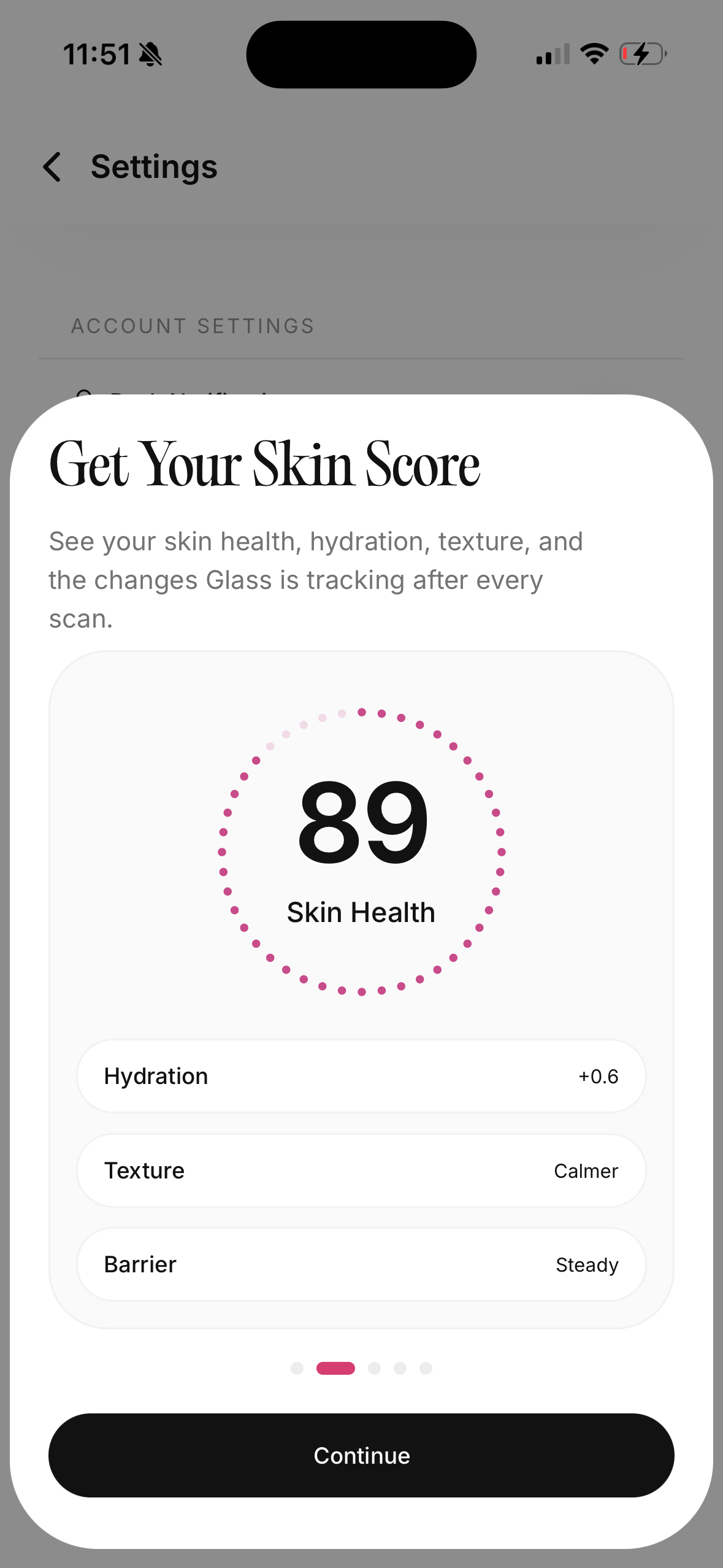
Glass is built around the part most skin apps skip: the connection between what your skin looks like and what your routine is actually doing.
The scan matters, but it is not floating by itself. It sits next to your routine, your products, your check-ins, and your progress over time. That makes the result easier to use because you are not just looking at a score and guessing what to change.
The point is not to make you stare at your face more.
The point is to make the next decision clearer.
If your scan keeps showing dryness and dullness, the answer might be a lighter hydration step, a better moisturizer match, or fewer harsh nights. If your skin looks more irritated after adding an active, the answer might be reducing frequency instead of adding another calming serum. If your routine is inconsistent, the scan might not be the problem at all. The pattern might simply need more time.
That is why I like tying analysis to routine tracking. It makes skincare less emotional.
The routine connection is the missing piece
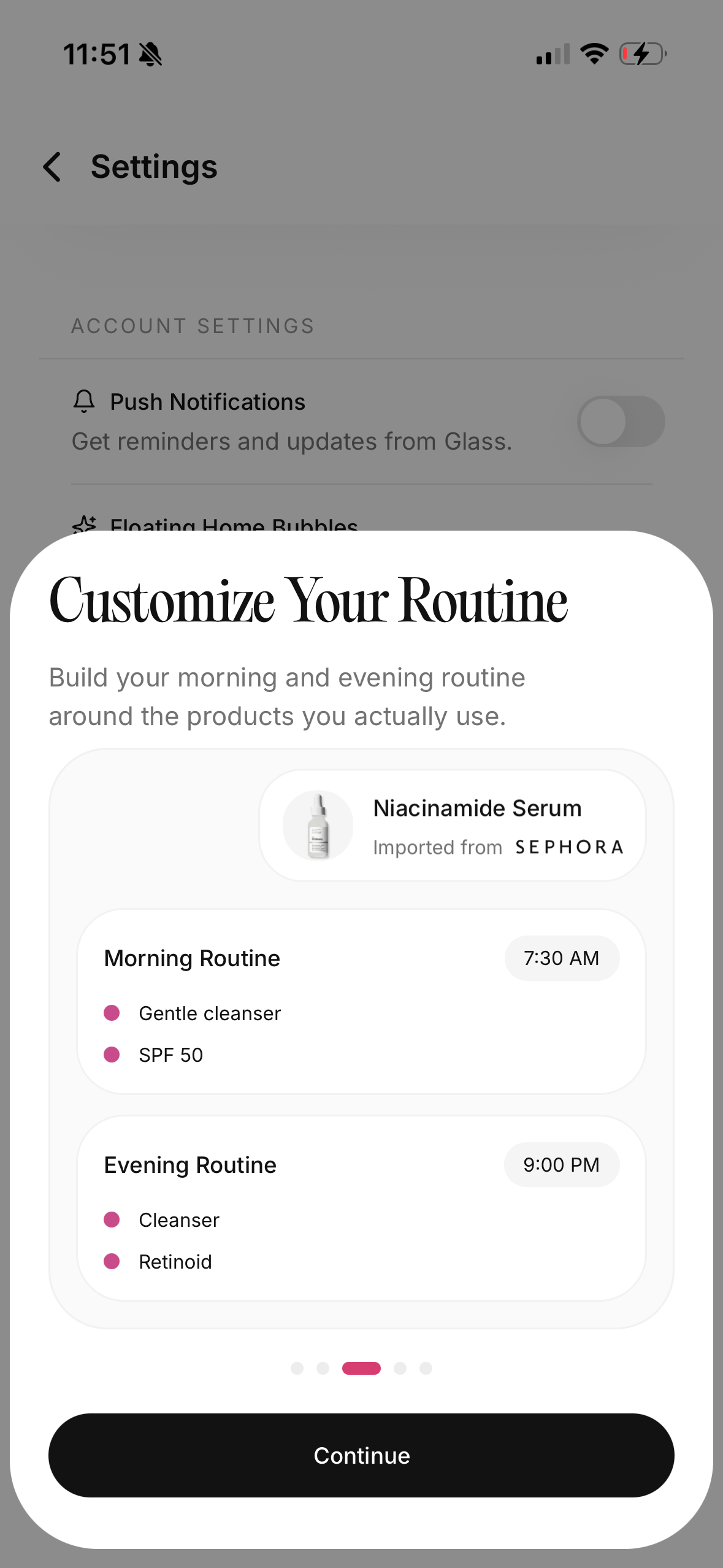
A scan without routine context is like a bank statement without dates.
You see the result, but not the behavior that created it.
That is the reason I would not choose a skin analyzer app that only gives me a report. Reports are easy. Behavior change is harder.
A useful app should help answer questions like:
- Did my skin improve after I simplified my morning routine?
- Did redness get worse after I added vitamin C?
- Did my breakouts calm down when I stopped switching cleansers?
- Did my skin look better because the product worked, or because I finally used moisturizer every night?
- Did my "bad skin week" line up with a skipped routine, travel, stress, or a new product?
Those are the questions people actually struggle with.
The most expensive mistakes in skincare usually come from changing too many things too fast. A routine-aware skin analyzer helps you slow that down.
What I would look for if acne is the main concern
If acne is your reason for downloading a skin analyzer app, I would be extra careful.
Acne is emotional. It makes people rush. It also makes apps tempting because a clean dashboard can feel more controlled than a mirror.
The app should help you track patterns without turning every blemish into a crisis.
For acne-prone skin, I would look for:
- clear photo history
- breakout location tracking
- routine notes
- product-change dates
- reminders that do not push you into over-cleansing
- the ability to track irritation and dryness, not just pimples
That last point is the one people miss.
If an acne routine clears bumps but leaves your face tight, red, and flaky, the app should help you notice that tradeoff. Otherwise you end up chasing clearer skin with a routine your barrier cannot tolerate.
If you are building around acne, glass skin routine for acne-prone skin, night skincare routine for acne-prone skin, and best salicylic acid cleansers at Sephora for acne-prone skin are better next reads than blindly adding another active.
What I would look for if sensitivity is the main concern
Sensitive skin needs a calmer app experience.
Not just calmer design. Calmer judgment.
If your skin stings easily, flushes quickly, or reacts to products that seem fine for everyone else, you need an app that helps you reduce variables. You do not need one that recommends a new product after every scan.
For sensitive skin, I would want:
- space to log reactions
- gentle routine reminders
- before-and-after photos across weeks
- clear tracking for redness and dryness
- no aggressive claims about instant correction
- easy notes for fragrance, acids, retinoids, or sunscreen changes
The goal is not to collect perfect-looking scan results. The goal is to figure out what your skin tolerates long enough to improve.
That is a quieter problem, but it is the one that actually matters.
If your skin is already irritated, I would start with skin barrier repair routine before building a bigger plan.
What I would look for if glass skin is the goal
Glass skin is where app tracking can be surprisingly helpful.
Not because an app can magically create glow.
Because glass skin depends on consistency.
The finish people want usually comes from smoother texture, calmer tone, better hydration, sunscreen consistency, and fewer routine swings. Those things are hard to judge day by day, especially if you keep changing products.
For a glass-skin goal, I would want the app to track:
- texture changes
- dryness and dehydration cues
- dullness over time
- routine completion
- sunscreen use
- product additions and removals
- whether the skin looks greasy or genuinely hydrated
That last line is where a lot of people get stuck. Shiny skin is not automatically healthy-looking skin. If your face looks reflective but feels tight, rough, sticky, or congested, the routine needs better balance.
For that specific problem, how to get glass skin without looking greasy is the page I would keep close.
Red flags I would not ignore
Some skin analyzer apps make me trust them less the longer I use them.
These are the signs I would watch for:
- It gives dramatic labels with no explanation.
- It recommends too many products immediately.
- It treats every scan like a fresh emergency.
- It does not separate lighting differences from skin changes.
- It gives medical-sounding certainty without medical care.
- It makes normal texture feel like a defect.
- It has no useful routine tracking.
- It pushes product shopping harder than progress tracking.
I do not mind product recommendations when they are thoughtful. I do mind when every scan becomes a shopping funnel.
Skincare is already noisy enough.
A good app should make it quieter.
How often I would scan
Daily scanning sounds disciplined, but I do not think everyone needs it.
For most people, two or three times a week is enough. That gives you a real record without turning your face into a project you have to grade every morning.
I would scan more often only if:
- you are tracking a specific flare pattern
- you just started a treatment and need careful notes
- your clinician asked you to monitor visible changes
- you are testing whether a routine is causing irritation
Otherwise, consistency matters more than frequency.
Same light. Same angle. Same time of day if possible. Clean face, or at least the same routine state each time. A mediocre scan setup repeated consistently is often more useful than a perfect photo taken randomly.
The biggest mistake is changing too much after one result
One scan should rarely change your whole routine.
That is where people get into trouble.
The scan says texture is worse, so they exfoliate. The skin gets irritated, so they add a barrier serum. Then breakouts show up, so they add a spot treatment. Suddenly the routine has five new variables, and nobody knows what helped or what hurt.
I would rather treat a scan like a note, not a verdict.
If the same pattern repeats across multiple scans, then it becomes useful. If dryness keeps showing up, adjust hydration. If redness keeps showing up after active nights, reduce frequency. If breakouts cluster after a new product, pause and watch.
That approach is slower.
It is also how you avoid wrecking a routine that was almost working.
The app I would choose
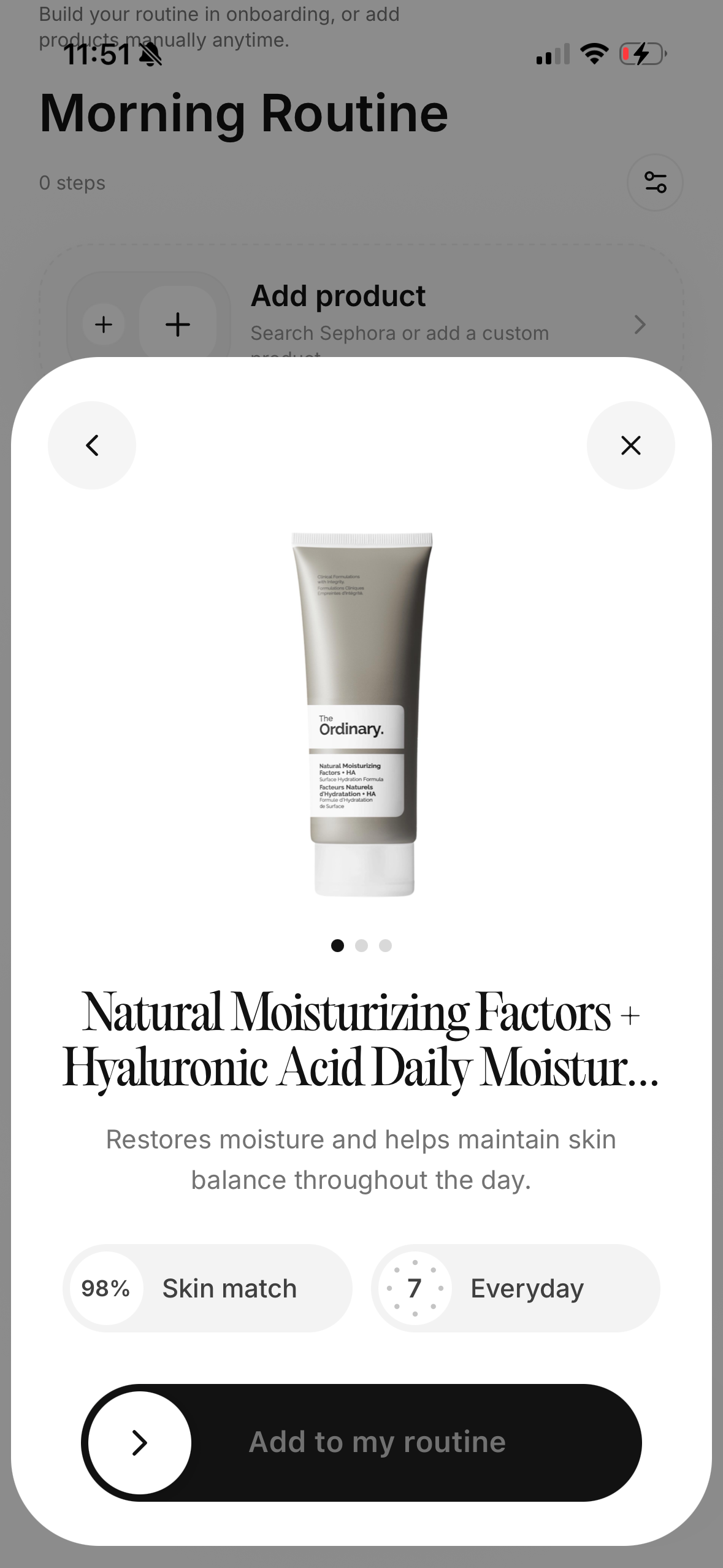
I would choose the skin analyzer app that makes me less reactive.
That is the simplest way to say it.
I want the scan. I want the photo history. I want the routine connection. I want product context. I want progress that feels grounded instead of dramatic.
That is the lane Glass is trying to own: skin scans that connect back to the actual routine, not a standalone result that leaves you guessing.
If you already know you want a skincare app more broadly, best skincare app 2026, best AI skin analysis app 2026, and best skincare routine tracker 2026 go deeper on the surrounding categories.
But if your question is specifically whether a skin analyzer app is worth using, my answer is yes with one condition:
Use it to track patterns, not to judge your face.
That one shift changes everything.
FAQ
What is a skin analyzer app?
A skin analyzer app uses your phone camera, guided photos, and software analysis to track visible skin patterns such as acne, redness, texture, pores, dryness, and uneven tone. The best ones also connect those patterns to your routine and progress history.
Is a skin analyzer app accurate?
It can be useful for visible tracking, but it should not be treated as a medical diagnosis. Lighting, angle, camera quality, makeup, sunscreen, and recent washing can all affect results. The trend over time is usually more useful than one scan.
Can a skin analyzer app replace a dermatologist?
No. It can help you organize photos, track routines, and notice visible changes, but it cannot replace medical evaluation. If something is painful, changing quickly, bleeding, spreading, or worrying you, get professional care.
How often should I use a skin analyzer app?
Two or three times a week is enough for most people. Daily scans can help during a specific test period, but they can also make you overreact to normal day-to-day skin changes.
What is the best skin analyzer app feature?
Routine-connected progress tracking is the feature I trust most. A scan result is much more useful when you can see what products you used, which steps you skipped, and what changed before the skin changed.